

£24
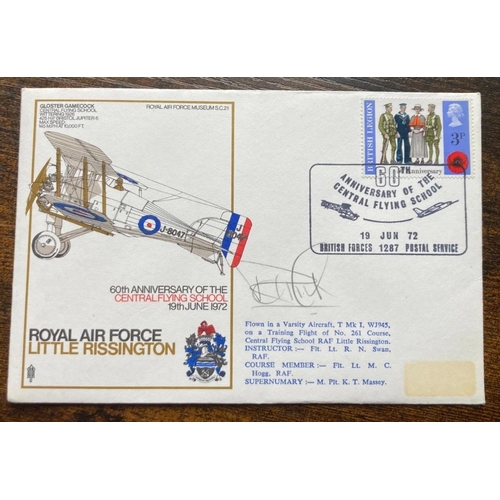
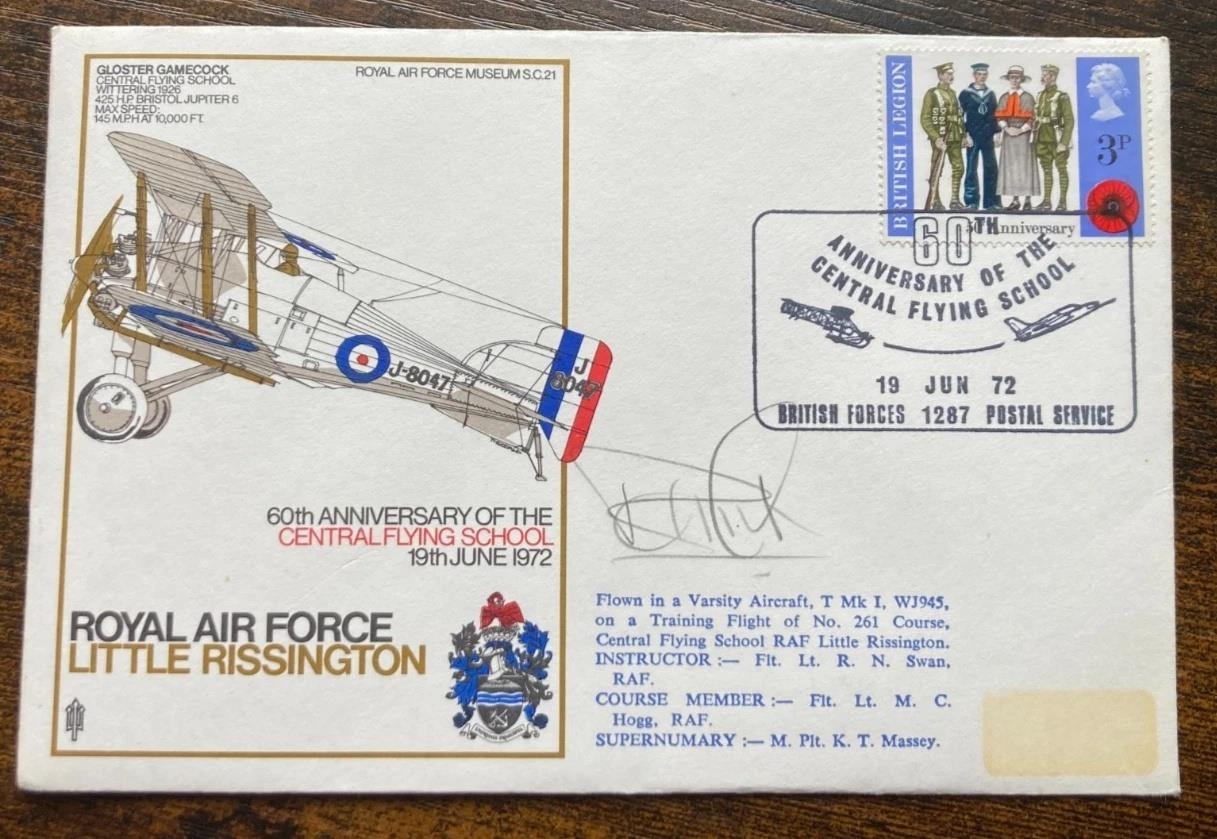
WW2 Rare Battle of Britain pilot C Bamberger 610 sqn signed RAF cover No4 of 10. RAF Little Rossington cover flown by Varsity comm. 60th ann Central Flying School. Cyril Stanley "Bam" Bamberger, DFC and Bar, AE (4 May 1919 - 3 February 2008) was a Royal Air Force pilot who fought in the Battle of Britain, the defence of Malta and the Korean War. Bamberger was called to full-time service on the outbreak of war, completed his training and rejoined his former squadron, now equipped with Supermarine Spitfire fighters, at Biggin Hill on 27 July 1940, as a sergeant pilot. Bamberger flew with No. 610 Squadron during the early air fighting over the Channel that followed the Dunkirk evacuation. The squadron suffered heavy casualties, but Bamberger was credited with the probable destruction of a Messerschmitt Bf 109 fighter on 28 August in combat off the Kent coast. When No. 610 Squadron was withdrawn to rest in mid-September 1940, Bamberger was posted to No. 41 Squadron at Hornchurch and was soon back in action in the Battle of Britain. He was credited with his first confirmed aerial victory, again a Bf 109, over Canterbury on 5 October. With the Battle of Britain winding down, Bamberger volunteered for Malta. He flew Hawker Hurricane fighters with No. 261 Squadron from Hal Far from late November 1940 and was credited with shooting down two Junkers Ju 87 dive bombers over Grand Harbour in January 1941. Bamberger joined No. 93 Squadron in 1942 and was deployed to Tunisia. He was commissioned as pilot officer on 9 February 1942 and promoted to flying officer on 1 October 1942. [4] With the same squadron, he returned to Malta in 1943 and was credited with another aerial victory, a Ju 87, on 13 July, this time over Sicily. Bamberger was awarded the Distinguished Flying Cross (DFC) which was gazetted on 28 September 1943. Promoted to flight lieutenant on 9 February 1944, he returned to the United Kingdom in July. Four months later he was awarded a Bar to his DFC. Bamberger was released from RAF service in 1946, and he returned to Lever before joining the management of a Guinness subsidiary. When No. 610 Squadron RAF was reformed as a Royal Auxiliary Air Force unit, Bamberger rejoined it as a flight commander and was given the rank of flight lieutenant. In 1950 he became the squadron's Commanding Officer, having converted to Gloster Meteor aircraft. After the outbreak of the Korean War Bamberger accepted a permanent RAF commission, and for most of the duration of that conflict was an intelligence officer at the Air Ministry. He was promoted to squadron leader on 1 January 1957. Bamberger later converted to flying helicopters and flew the Bristol Sycamore aircraft in Aden. He retired in 1959, after being awarded the Air Efficiency Award with clasp. Good condition. All autographs come with a Certificate of Authenticity. We combine postage on multiple winning lots and can ship worldwide. UK postage from £5.99, EU from £7.99, Rest of World from £9.99
Fees apply to the hammer price:
Free Registration
28.74% inc VAT*
Flat Fee Registration
25.14% inc VAT*