£200,000
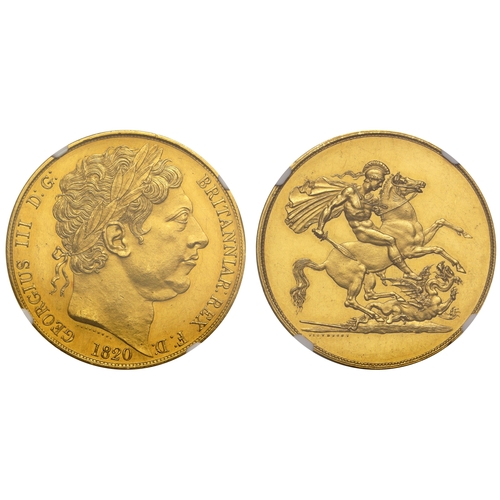
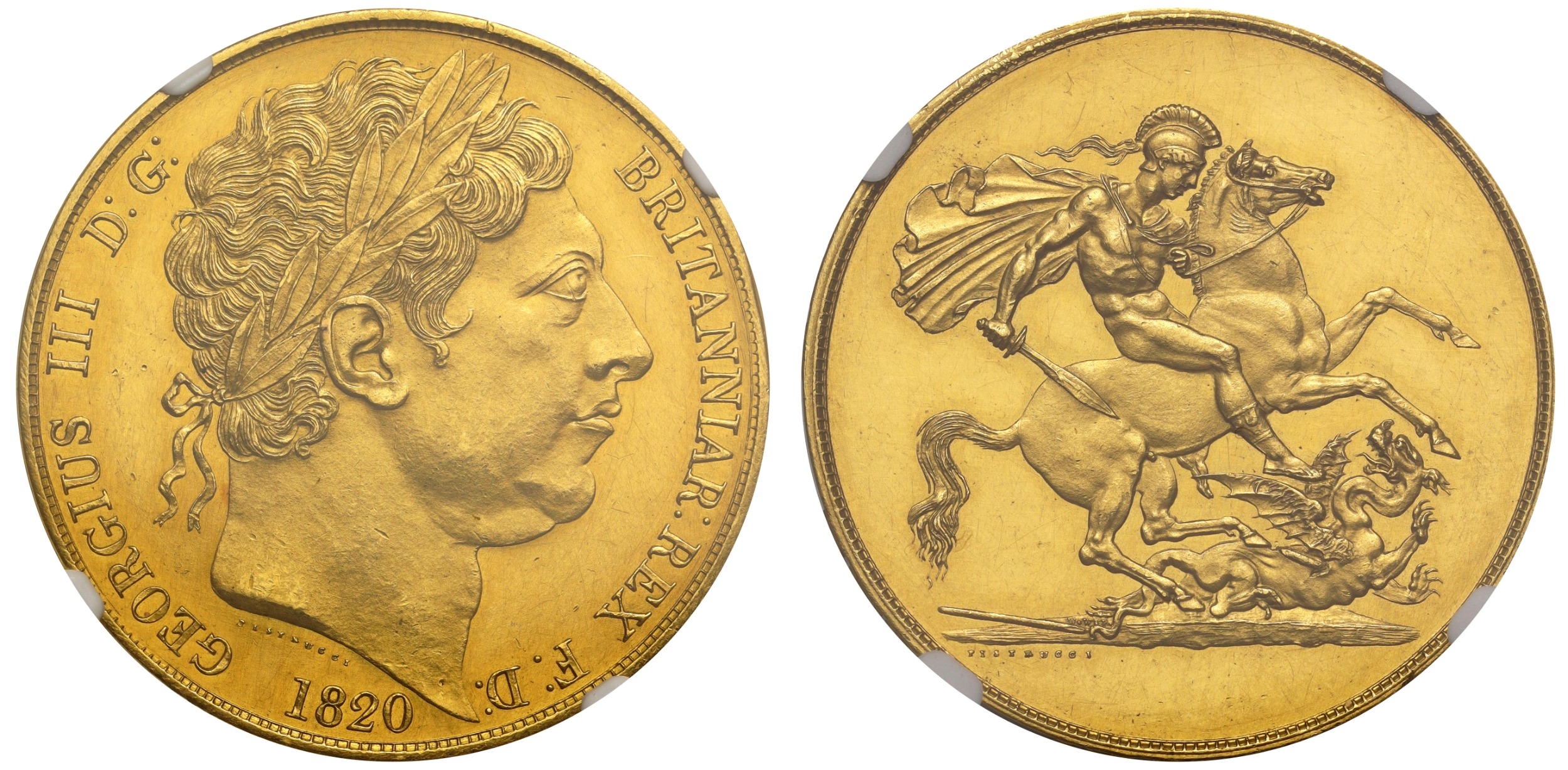
g George III (1760-1820), gold Pattern Five Pounds of Five Sovereigns, 1820, engraved by Benedetto Pistrucci, laureate head facing right, date below, PISTRUCCI in tiny letters below truncated neck, Latin legend and outer border surrounding, GEORGIUS III D: G: BRITANNIAR: REX F: D:, rev. inverted die axis, St George and dragon depicted right, St George holding sword and reins, dressed with flowing cape, helmet with streamer, broken lance to left on ground with raised W.W.P to right side for Master William Wellesley Pole, PISTRUCCI in tiny letters to upper left of exergue, outer border decoration surrounds, edge inscribed in raised letters, DECUS ET TUTAMEN * ANNO REGNI LX *, 39.91g (Hill F1; Linecar & Stone 207 this coin listed with Gilbert provenance; W.R. 177 R4; EGC 888 R4; Holloway 95; S.3783). Lightly toned with cameo effect, fields lightly hairlined, a couple of tiny digs in field near ties of wreath, a couple more on neck with very light abrasions, short scratch in field by eye, reverse with hairlines and very light abrasions in field to right of horse, otherwise has been slabbed and graded by NGC as PF60 Cameo, very rarely available with only 25 lettered edge pieces struck, one of the most highly coveted coins of the entire milled series being the first Five Sovereign piece ever minted.
NGC certification 67694350-004 with St Helier Collection label.
We note as of March 2025 that NGC have graded just five of the 1820 lettered edge Five Pounds whereas PCGS have graded seven but there could be double counting with re-submitted coins between the services.
The Latin legends translate as George the Third by the grace of God, King of the Britons, Defender of the Faith on obverse, with the edge inscription meaning An ornament and a safeguard in the sixtieth year of the reign.
Provenance:
Ex A. H. Gilbert, Glendining, 13th March 1963, lot 98, sold for £1,750.
Ex Spink and Son Ltd, sold privately 19th March 1963 as per accompanying old ticket for £1,925.
Ex St Helier Collection, Spink, 31st March 2023, lot 711
One of the most highly coveted coins of the entire milled series the first gold Five Pounds ever issued, or Five Sovereigns as it appears in official papers, is a master work of the Italian engraver Benedetto Pistrucci who as a favourite of William Wellesley Pole (Master of the Mint 1814-23) was the chief engraver in all but name being from overseas.
The dies for the Five Pounds and its accompanying Two Pounds were in final preparation in the twilight of George III's reign, and a brief account of their production is provided in the Numismatic Chronicle, Volume 13, April 1850 - January 1851, in the article English Gold Coins by Edward Hawkins (1780-1867) who had been appointed Assistant Keeper in the British Museum's Department of Antiquities from 1825 until retirement around 1860. The account is a very useful read as it tell us that the dies were scarcely finished upon when news of the King's death was expected hourly, so the workers concentrated on striking the coins throughout that night, but the finished coins were not actually ready until after the King had passed, as he had died at just after 9pm on the evening of 29th January aged 81. The coins were then issued in a very limited number as a memorial to the Late King and 25 pieces were officially struck of the gold Five Pounds and 60 examples of the gold Two Pounds. The quantity of the Two Pounds was allegedly higher than originally expected due to a supposed error in reading the order.
Hawkins chronicle account is especially useful as it reveals the names of all the recipients of the Five Pound pieces which we give below, the order being listed as Hawkins received them:
Mint Cabinet
Bank of England
British Museum
Dublin College
Bodleian Library
Marquis Salisbury
Marquis Salisbury1
Mr Atkinson
Mr Bingley
Mr H Bingley
Mr Field
Mr Finch
Mr Morrison
Mr Mushet
Mr Wyon
Mr C Barclay
Mr Dimsdale
Mr Durant
Mr J Edmonds
Mr C Edmonds
Sir T Freeling
Mr Hawkins
Mr Henderson
Rev. J Martin
Mr Trattle
1Hawkins tells us the second entry for the Marquis should really be substituted for Mr Henderson who is on the list below.
The George III 1820 Five Pounds remains a piece of coin art of the highest calibre with Pistrucci's treatment of the head of George III giving a most life-like image and thus coupled with his classic rendition of St George slaying the dragon with a sword being the precursor to the classic design used a year later for the first time on the 1821 Sovereign and continues to this day as the reverse design for modern annual Five Pounds, Two Pounds, Sovereigns, Half-Sovereigns and Quarter-Sovereigns, this is the design that inspired them all!
The artist Pistrucci was allowed to place his surname in full on each side of these coins and Master of the Mint William Wellesley Pole the brother of the Duke of Wellington also had his initials placed on the groundline over the broken lance perhaps as a mark of pride that such a design was produced under his tenure at the Mint. Pole was also instrumental in setting up what has latterly become the Royal Mint Museum with the order given to keep specimen examples of all coinage produced from the end of George III's reign onwards.
There are also three examples of plain edge versions known of this Five Pound piece, which must have been struck as a prototype before the lettered edge collar was introduced or as additional pieces of pleasure - perhaps for the likes of Pistrucci and Pole themselves who were not on the official list above. A die study would be required to see if a sequence could be worked out to see if the plain edge either preceded or followed the 25 lettered edge examples.
Of the 25 struck of the Five Pounds there are perhaps as many as twelve to fifteen pieces in commerce to this day with some others having made their way to or remaining in institutions. As far as we know none of the modern-day examples can possibly be traced back with confidence to the original recipients at all, a practically impossible task as before 1960 most auction catalogue appearances feature plates made up from the plaster cast process of preparation. This means the photography is not usually of the live coin itself and only some key named catalogues use direct photography making it difficult to accurately trace what is a uniformly made milled coin. Going back further in time before 1900 this becomes an even harder task with only a few catalogues utilising images from the early days of close- up photography coupled with many listings being text only it is only if a provenance trail is quoted that such coins can be traced further.
What is clear is that the Five Pound piece quickly became a collector's piece with its known edition limit far outstripping other Proof Five Pounds that came later for 1826, 1839, 1887, 1893 and so on into the 20th Century. In the following decades afterward, we see reports of these coins sold in major collections including some of those of the original recipients selling for over £20, more than four times the original face value. To compare we see 1839 Una and the Lion £5 pieces of which hundreds were struck selling at auction for just over the face value towards £6 and it is not till many decades later that this shows a more marked increase.
Moving to the more modern day and the boom in coin collecting of the early 1980s, the George III Proof Five Pounds of 1820 was the most valuable priced coin in the Seaby Standard Catalogue 1980 listed at £20,000 when a Victoria Una and Lion £5 piece was half the value at £10,000. In the 45 years since then the now Sovereign Rarities catalogue has become more detailed, with more prices of the extreme rarities quoted in milled and hammered coins. Trends have changed too in collecting and the Una and Lion of great demand is now priced within 50% of the 1820 Five Pounds on the values quoted of £475,000 on the 1820 and £350,000 on the 1839 in FDC. However, there are other rare coins now priced higher like the Vigo Five Guineas of 1703, of which slightly more examples are known and available at £750,000 in EF and George III Five Guinea pieces at £575,000, both coins that were extremely rare and unpriced in the 1980 catalogue. What this demonstrates is that the extreme rarity of the 1820 Five Pounds with only 25 struck is perhaps not as well appreciated as it once was some half a century ago. The current thirst for high value large gold coins has meant more common Five Guinea currency pieces in higher grades regularly sell for six figure sums and over 200 pieces of this denomination are in the MS grade levels, whereas the much rarer lettered edge 1820 Five Pounds can only ever have a maximum ceiling of 25.
Fees apply to the hammer price:
Free Registration
27.6% inc VAT*
Flat Fee Registration
24.00% inc VAT*