€20,000 - €30,000
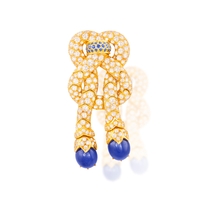
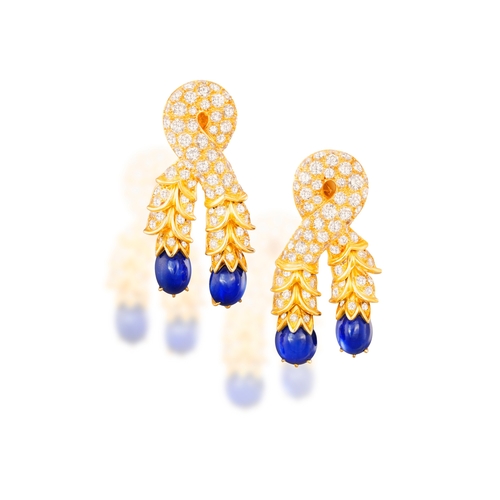
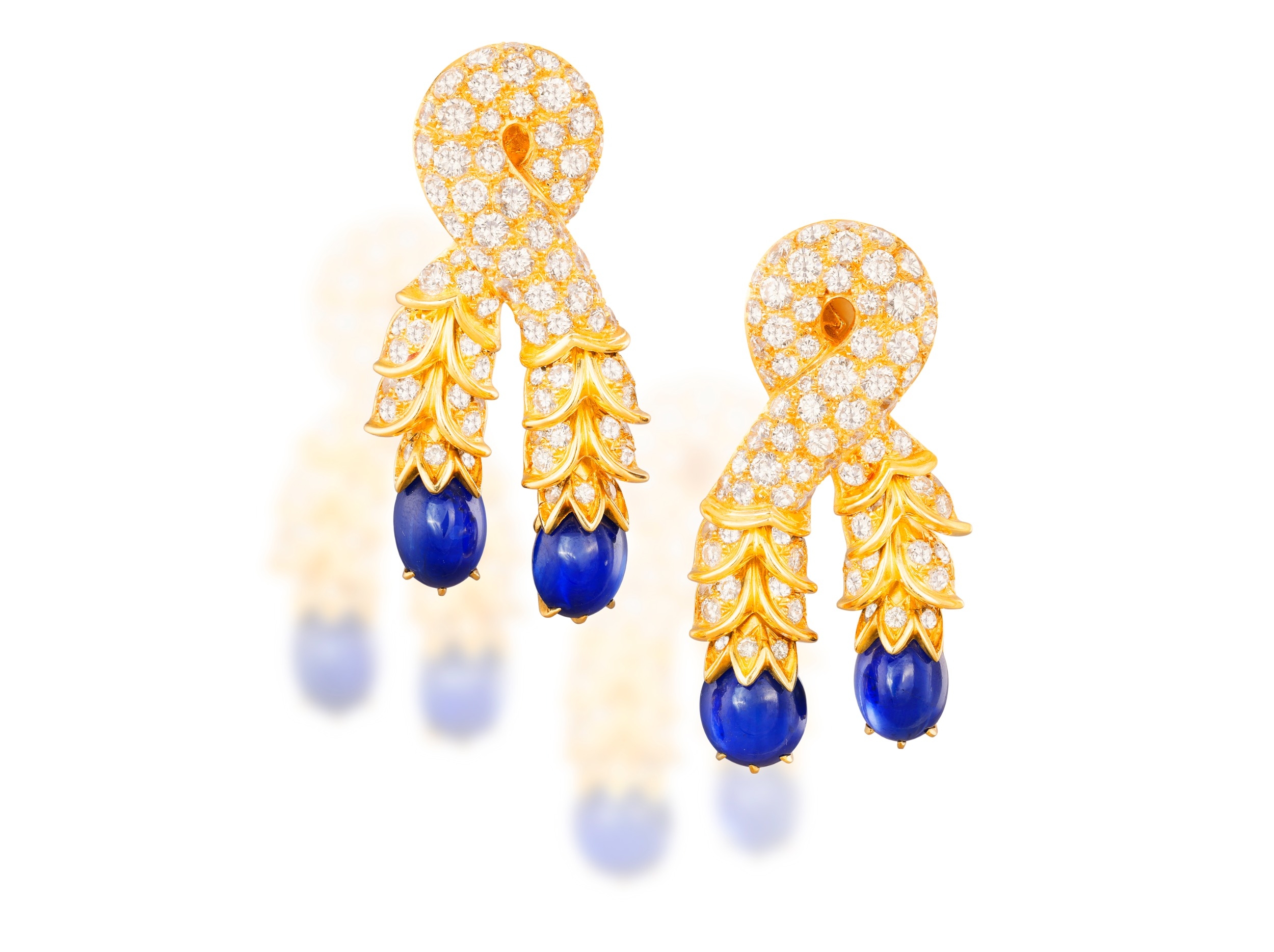
RENÉ BOIVIN, DESIGNED BY JULIETTE MOUTARD: A RARE AND COLLECTIBLE PAIR OF SAPPHIRE AND DIAMOND 'NOEUD DE PASSEMENTERIE' EARCLIPS, CIRCA 1965
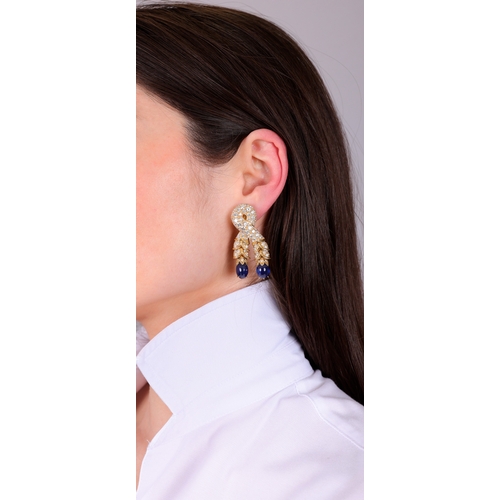
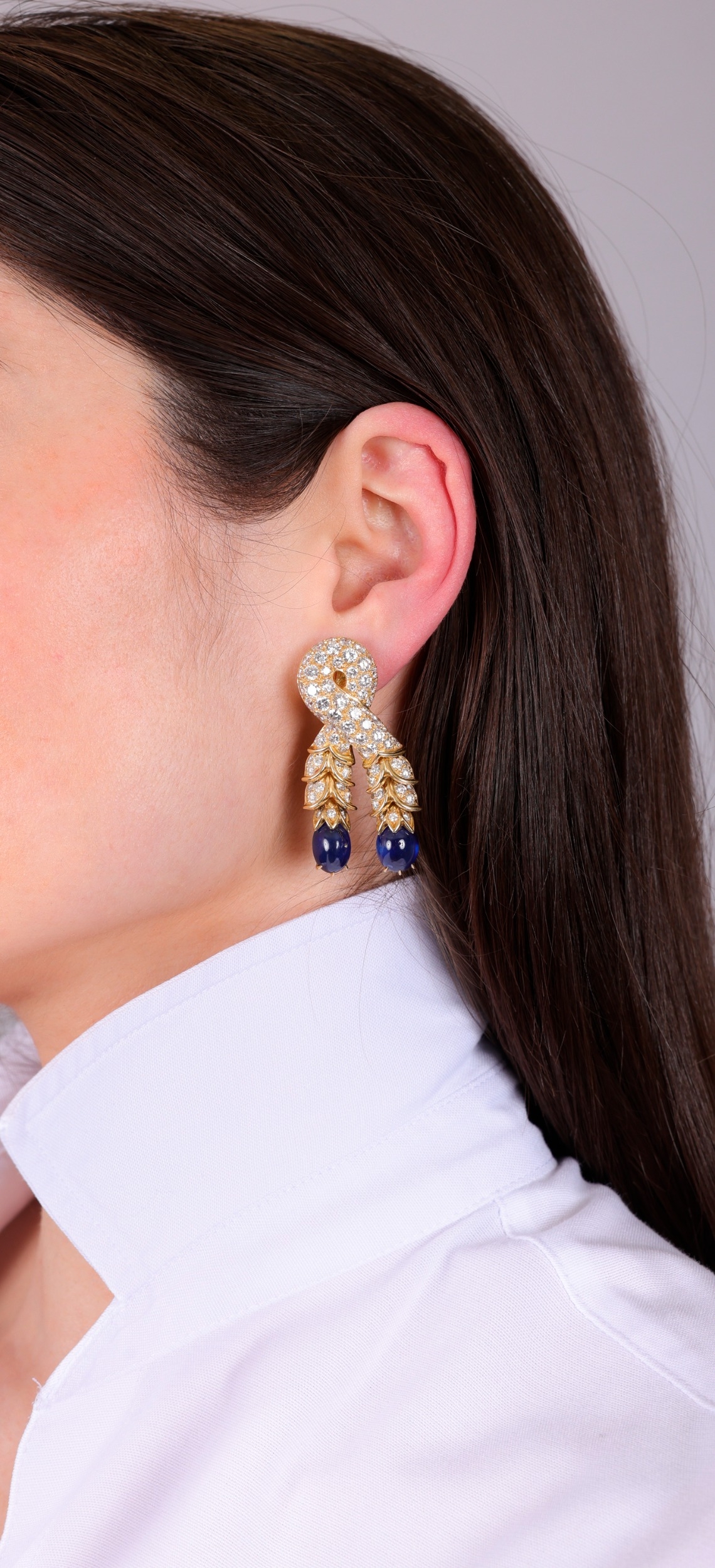
Each designed as a stylised knot, pavé-set with brilliant-cut diamonds, suspending two articulated tassels pavé-set with brilliant-cut diamonds, highlighted with two oval-shaped sapphire cabochon drops, mounted in 18K gold, diamonds approximately 12.00cts total, sapphires approximately 20.00cts total, signed R. Boivin, with maker's marks for René Boivin, French assay marks, length 5cm
A similar pair sold at Sotheby's in Paris, on April 30th 2019, lot 169, for €50,000.-
René Boivin: Joaillier, Francoise Cailles, Paris, 1994, page 320 for similar models.
At the turn of the twentieth century, women were only beginning to enter the workplace in any real numbers. The First World War accelerated the shift: with so much of the country's labour directed toward reconstruction, women moved into roles that had long been closed to them. In the world of jewellery, traditionally and fiercely male, a handful of exceptional women emerged not just as contributors, but as the creative minds behind some of the era's most extraordinary work.
The French firm of Boivin, founded in Paris in the 1890s by René Boivin, is considered to have produced some of the most original and finely wrought jewels of the twentieth century. René was born in 1864 and, after school, joined his older brother Victor's business as a goldsmith's apprentice at seventeen, learning his craft through inlaid metalwork and engraving before becoming a highly skilled draughtsman. In 1893 he married Jeanne Poiret, whose brother Paul was already the most celebrated couturier in Paris, a connection that brought Maison Boivin into a remarkable circle of artists, intellectuals, and society figures from the very start.
René died in 1917 at just 53, at the height of the firm's reputation. His death, swiftly followed by that of his only son Pierre, could easily have spelled the end of Maison Boivin. Instead, Jeanne decided to carry on. No woman had ever before headed an important jewellery firm. She had run the business alongside her husband for over two decades, and she knew it well. She fulfilled existing orders, took on work from other houses to keep things going, and used that period to quietly build the creative vision that would define the Maison's best years. She had no interest in fashion for fashion's sake, favouring bold, voluminous pieces set with large coloured stones, sculptural in form, unapologetic in presence, and always deeply feminine.
The most important hire of her time came in 1933, when Jeanne brought on Juliette Moutard as the Maison's principal designer. Born in 1900, Moutard was a gifted and meticulous designer who had trained at a Parisian watchmaking firm, work that gave her a remarkable feel for articulation and movement that shows in everything she made. The two women were a natural fit: one gave shape and substance to the ideas of the other, who then closely supervised every stage of manufacture down to the last detail. Moutard had no time for trends. She was drawn to the fluid, sensual forms of the natural world rather than the geometric cool of Art Deco, a preference she shared with Madame Boivin, and one that gave the firm its singular character. While most contemporaries were still working in the abstract severity of the period, Boivin's designs grew more playful and alive, full of flowers, creatures, shells, and the sea.
In 1938, Germaine Boivin, Jeanne's daughter who had been working for her uncle Paul Poiret, officially joined the firm. With all three women now in place, the Maison hit its stride. Clients rarely received a price estimate or a delivery date, something that became, among the right circles in Paris, simply part of the pleasure of owning a Boivin piece. Jeanne felt the jewellery was distinctive enough to need no signature. It drew exactly the clientele that sort of confidence tends to attract, among them Millicent Rogers and the Duchess of Windsor, both devoted to the Maison's bold and utterly original work.
Madame Boivin retired in 1954 and died five years later in 1959, leaving the firm to Germaine. Juliette Moutard stayed on, working until her retirement in 1970. She died in 1990. What she left behind, jewels made across nearly four decades, speaks for itself: pieces that felt ahead of their time when they were made, and have never quite caught up with since.
Diamonds: approx. 12.00cts total, unable to assess colour due to yellow mount, bright and lively, estimated clarity VS
Sapphires: approx. 5.00-5.50cts each, of blue hue, medium tone, semi transparency, natural inclusions visible under a bright light source
Both signed R. Boivin, both with maker's mark: Sté R (snake) B
Both with eagle's head for French 18K gold
For non pierced ears - both with good tension
Minor signs of wear, overall in good condition
Total gross weight approx. 42.2g
Fees apply to the hammer price:
Free Registration
28.6% inc VAT*
Flat Fee Registration
25.00% inc VAT*