£180
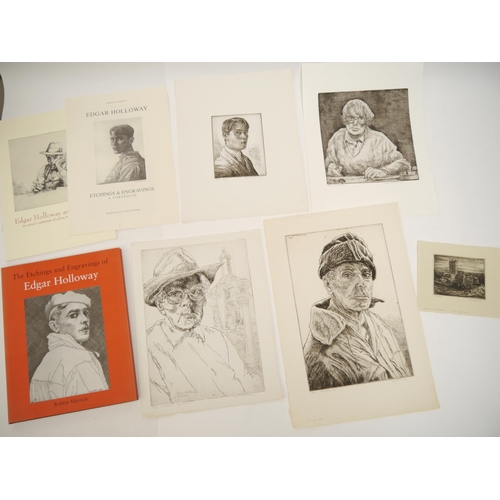
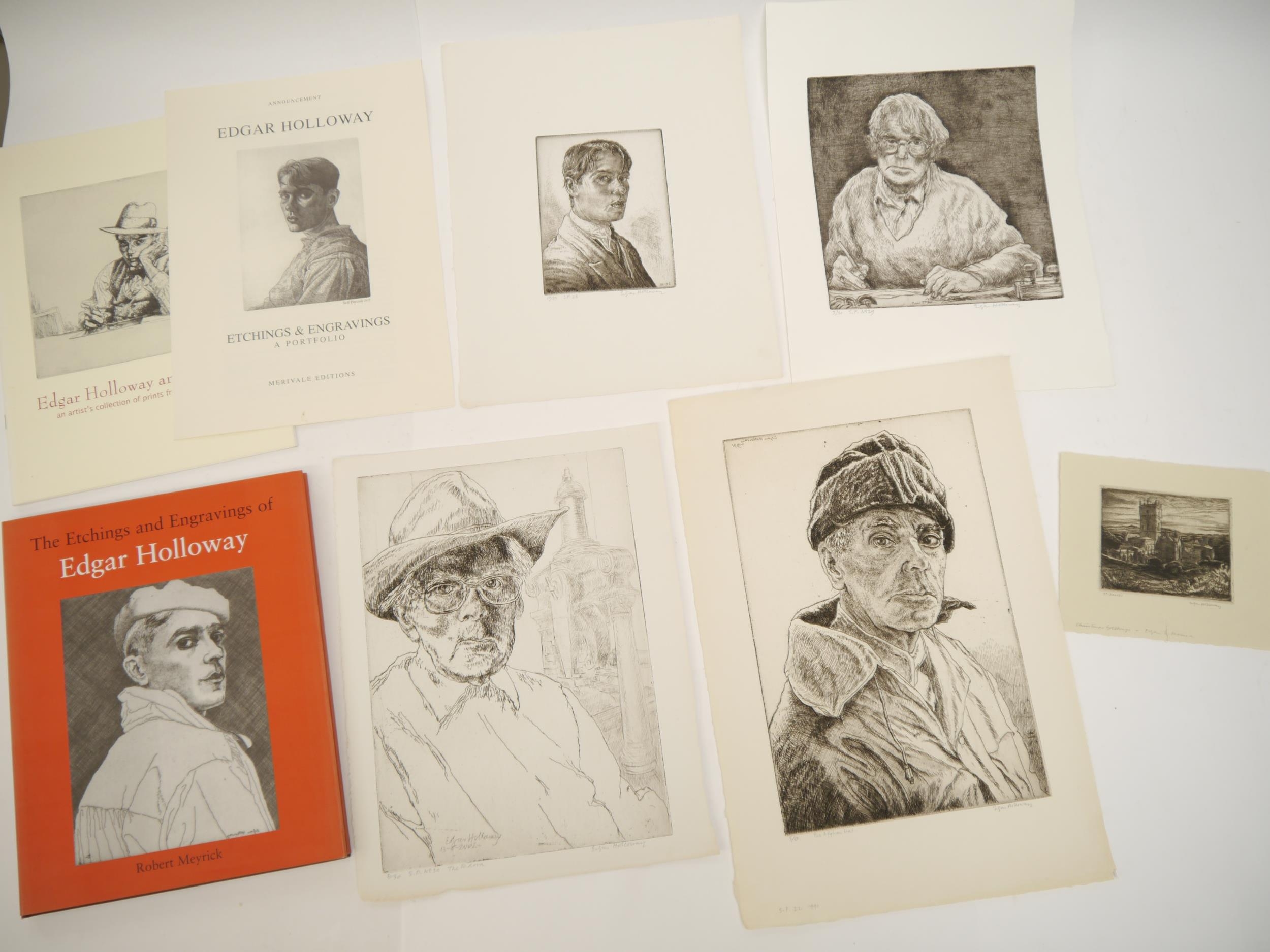
Edgar Holloway (British, 1915-2008), a folder containing five original signed etchings, together with a prospectus, a copy of the catalogue raisonné 'The Etchings and Engravings of Edgar Holloway', by Robert Meyrick, Scolar Press, [1996], plus 1 other publication about Holloway, the etchings comprising:
'Self Portrait No.22 The Afghan Hat', 1991, No. 5/50, signed, titled and numbered in pencil by the artist to lower margin, 284 x 190mm, signed in reverse on the plate "Edgar Holloway 1991", probably 4th state (i.e. the published version), not the Merivale version. (Meyrick No.262)
'Self Portrait No.23 (July 1932)', 1992, No. 17/50, signed, titled and numbered in pencil by the artist to lower margin, 139 x 102mm, Edition not declared, Exhibited RE 1993, EH80 1994, after a pencil drawing dated July 1932. (Meyrick No. 270)
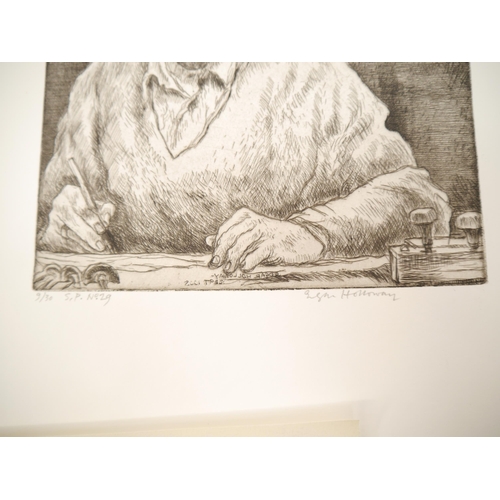
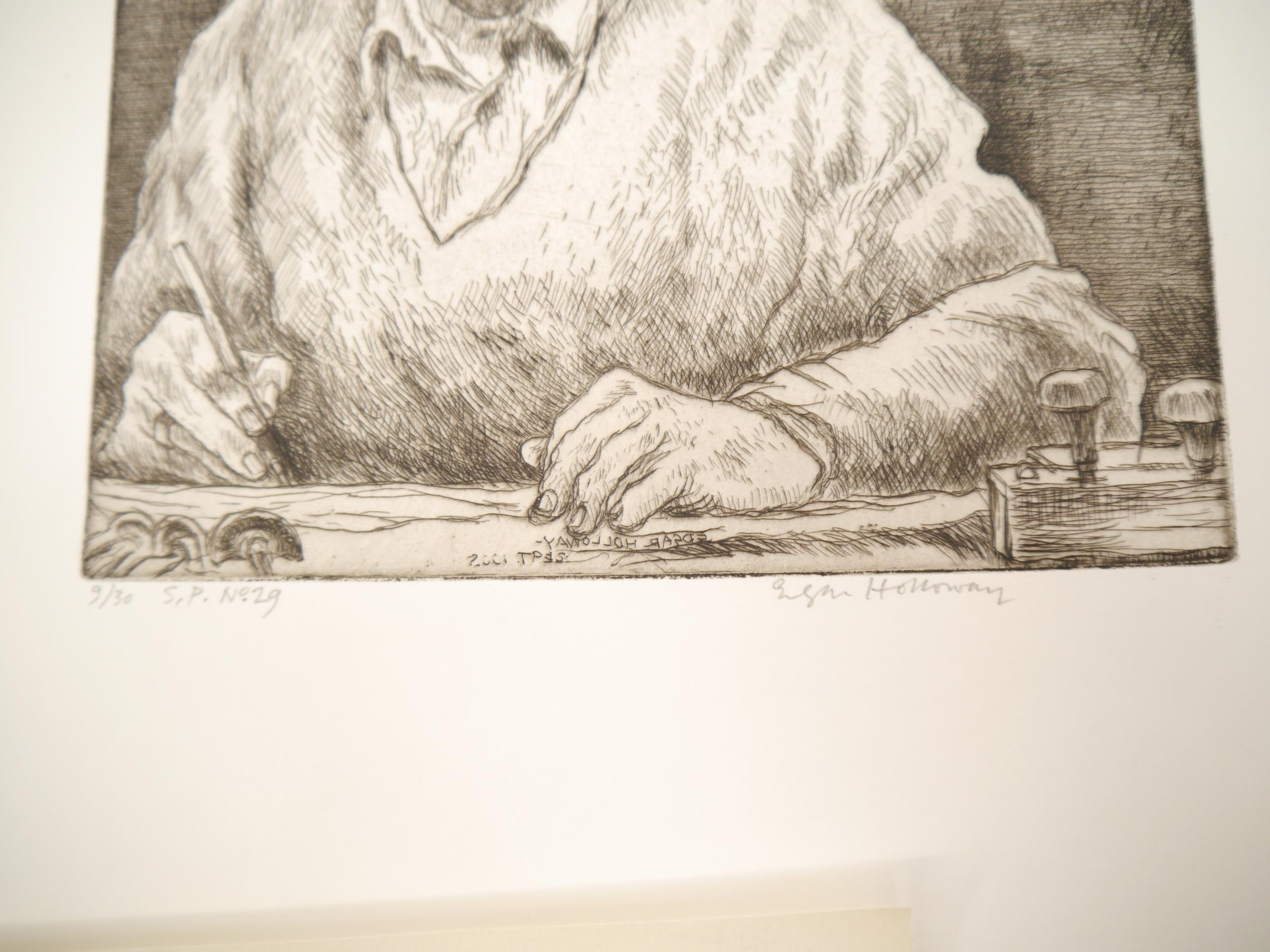
'Self Portrait No.29', [nd, c.2001], No. 9/30, signed, titled and numbered in pencil by the artist to lower margin, signed in reverse on the plate "Edgar Holloway Sept. 2001[?]", 198 x 185mm. (Not in Meyrick)
'Self Portrait No. 30 The Fedora', 2002, No. 2/30, signed, titled and numbered in pencil by the artist to lower margin, signed on the plate "Edgar Holloway 13-8-2002-", 139 x 102mm. (Not in Meyrick)
'St. David's Cathedral, Pembrokeshire', 1973, 1st state (one of 75 impressions without the inscription on the plate), titled, signed and with a pencil inscription by the artist "Christmas Greetings. Edgar and Monica", 79 x 99mm, small closed tear lower margin (approx. 12mm, not affecting image). (Meyrick No.211)
Edgar Holloway was born in Yorkshire in 1914. Largely self-taught, Holloway learned to etch from books and manuals and was influenced by the self-portrait etchings of Rembrandt, Whistler and Augustus John. Like John, he used self-portraiture as a means of exploring different aspects of his personality, sometimes adopting an alternative persona. Encouraged by Campbell Dodgson and Muirhead Bone, Holloway had his first one-man show in London at the early age of 17. Portraits won particular acclaim and TS Eliot, Stephen Spender and Herbert Read were among the many who sat for the artist. Whilst in Wales in 1943 he visited the Gill family and met Daisy Hawkins, who had left her Ditchling home to work for them. They married six weeks later. When short of work in the post war period he turned his skills to drawing letters for a sign. This became the first of many jobs of lettering and sign writing that he continued throughout his working life. In 1948 he visited Ditchling and settled in the following year. He began to study wood-engraving with Philip Hagreen and by 1951 had joined the Guild. Throughout his life he worked as a designer for publishers and a cartographer as well as continuing to etch and work in watercolour, the village itself and the Guild buildings, providing his subject matter.
Fees apply to the hammer price:
Free Registration
23.6% inc VAT*
Flat Fee Registration
20.00% inc VAT*